We use cookies to personalise and enhance your experience on this site. By clicking Accept or continuing to use the site, you agree to our use of marketing and social media cookies as described in our Privacy Policy.
Accept and close
As London Tech Week draws to a close, we’ve been delighted to see renewed momentum around responsible, people-centred AI adoption at work, whether through DSIT's announcement of the Pro-Worker AI Adoption Prize, or embedded in the HM Treasury's plans for the new AI Economics Institute.
The Prize recognises and promotes AI adoption that strengthens worker capabilities alongside productivity. It arrives amid recent ONS findings that a lack of knowledge of AI use cases remains a key barrier to adoption.
Launched at our Making the Future Work conference, our collection of new action-research case studies across eight organisations responds to this gap, showing in practice how successful AI adoption is a people-centred challenge, shaped by good work design. You can find the full selection of conference recordings here.
From the Pissarides Review, we know that outcomes for firms and the wellbeing of workers cannot be disentangled. This is the approach at the heart of our ongoing work for the Mayor of London's AI and Jobs Taskforce, which targets the interface between responsible innovation and good governance. The Taskforce reports in July, with pilots and prototypes designed to be of strong practical value for individuals, firms, mayors, and governments worldwide, and we warmly invite you to engage with us as this work develops.
Lastly, commentary pieces by IFOW Directors Anna Thomas MBE and Dr Abby Gilbert explore the wider impacts of AI adoption - from young people's transitions into work, to global debates on AI ownership, value capture, and accountability.
Anna and Team IFOW
This London Tech Week, DSIT and HM Treasury launched the AI Economics Institute. The Government’s aim is clear: to capture the benefits of AI for the whole economy by building the data infrastructure and analytical capability needed to assess AI’s economic impacts.
The announcement lands in a moment of unprecedented cross-party convergence in the US on how the American public could secure a direct stake in the value of AI, through a sovereign-wealth fund or another public ownership model.
In the UK, however, the question is different. As the AI Economics Institute takes shape, the challenge is not only how to distribute AI’s gains, but how to capture and protect the underlying assets feeding into these systems: the knowledge and ‘know-how’ of the workforce itself.
In our latest blog, Dr Abigail Gilbert explores how this ‘know-how data’ is being quietly absorbed into foundation models - and how failing to govern it risks a large-scale transfer of value and capability overseas.
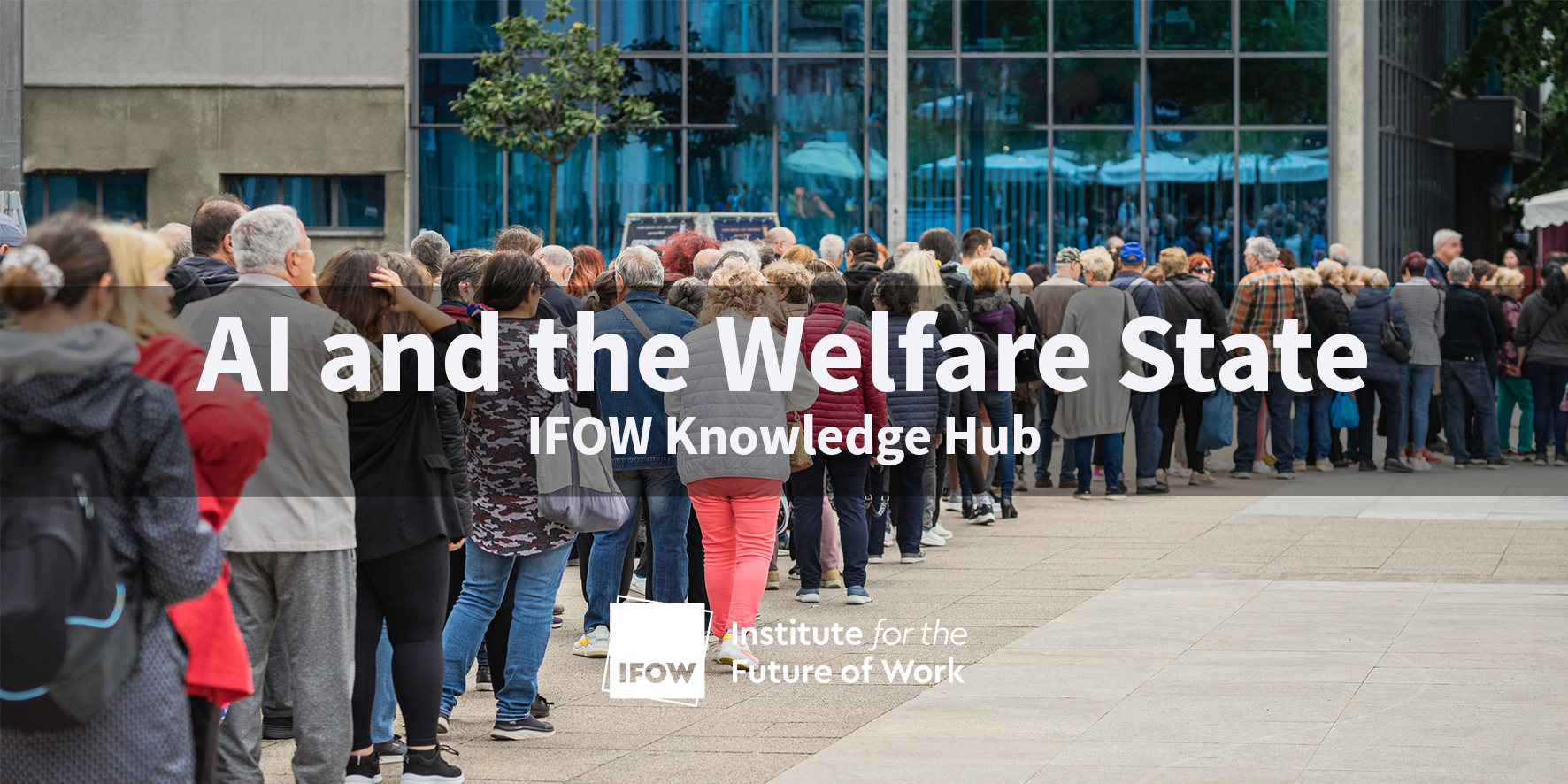
The welfare state has been intertwined with work since its inception in the late 19th century. Here, IFOW researcher Joana Geisler has curated a selection of leading recent research on how today’s welfare state institutions, such as trade unions, are shaping how technology transforms work - whilst the welfare state is also reshaped by technology.
The full selection can be found in the IFOW Knowledge Hub, following our last shelf by Dr Magdalena Soffia on the impacts of workplace AI tools on democratic participation.
AI, the Future of Work, and the Politics of the Welfare State | Chueri (2026)
This analysis of an OECD survey suggests that publicly anticipated AI disruption of the labour market is reshaping welfare state support. Anxieties about AI automation cut across educational groups and are strengthening support for new forms of protection, such as a UBI or robot tax.
We’re NHS analysts organising together against Palantir. Here’s why. | NHS Analysts Together (14 May, 2026)
A recent IFOW report argues that the UK workplace data must be safeguarded to support economic sovereignty. The welfare state should do the same, according to an open letter by NHS Analysts arguing that Palantir’s Federated Data Platform (FDP) is a risk to patient trust, staff wellbeing, data quality and infrastructure, and, importantly, national sovereignty.
Can the welfare state protect workers in the age of platform work? The new policy and politics of welfare in the digital economy | Antonucci & Palier (2026)
Platform workers) have long been a blind spot within the welfare state system. This piece discusses how welfare states shape the availability of platform work and the (potential) responses, by state and unions, to improve social rights for platform workers.
Building smarter government with AI and automation | 17 June, 11:00-12:00, online
This webinar, hosted by TechUK, will explore how public sector organisations are using analytics, automation, and AI to improve efficiency, reduce duplication, strengthen financial and compliance controls, and enable more trusted insight-sharing across departments.
LSE – Will AI secure humanity’s future?| 20 June, 15:30-16:30PM, hybrid
Part of LSE’s 2026 Festival, this expert debate explores the risks and opportunities of AI for economies, societies, daily interactions, and the institutions that support them.
Work and Health Summit | 23 June, 9:30-14:00, in-person
Seven months on from the final report of the Keep Britain Working Review, the Work Foundation will bring together Sir Charlie Mayfield (Co-Chair of the Keep Britain Working) at this Summit, alongside leaders from business, policy and the third sector to discuss supporting more people to stay in and return to work.