We use cookies to personalise and enhance your experience on this site. By clicking Accept or continuing to use the site, you agree to our use of marketing and social media cookies as described in our Privacy Policy.
Accept and close

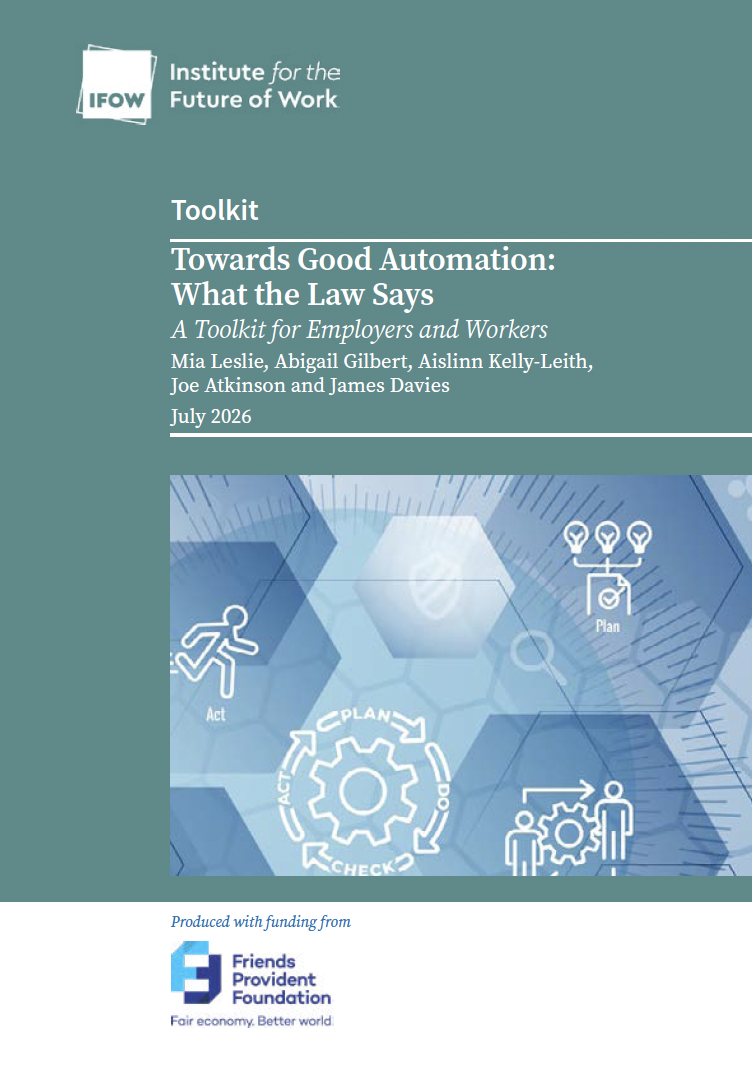
A practical, interactive toolkit for employers, workers and policymakers navigating workplace automation.
This toolkit translates IFOW’s research on automation into a practical framework for understanding the legal duties and protections that apply when workplace technologies are introduced or changed. It is designed to help stakeholders anticipate and respond to the different risks, impacts, opportunities and challenges that automation can bring to working lives.
The toolkit is structured around seven automation archetypes - Creation, High Discretion Augmentation, Low Discretion Augmentation, Intensification, Matching, Telepresence and Displacement - reflecting the different ways technology can transform work. For each archetype, it maps relevant legal duties and protections across four stages of technology adoption: Involve, Assess, Act and Monitor.
By bringing these legal requirements together within a practical framework, the toolkit supports users in identifying what protections and responsibilities apply at different stages of the adoption process, and in considering what action may be needed.
The toolkit is designed for multiple audiences.
By translating research and the existing legal landscape into a practical framework, the toolkit aims to support better-informed decisions about how workplace technologies are introduced, implemented and governed.
Mia Leslie, Abigail Gilbert, Aislinn Kelly-Leith, Joe Atkinson and James Davies
Tool
People-Centred Adoption