We use cookies to personalise and enhance your experience on this site. By clicking Accept or continuing to use the site, you agree to our use of marketing and social media cookies as described in our Privacy Policy.
Accept and close

Artificial Intelligence (AI) is already reshaping work and working lives. Politicians and practitioners alike are lured by bold promises of significant gains in efficiency and productivity. Much less is known about how AI innovation can translate into a wider range of good outcomes - including new job creation and improved work quality - and where the process of adoption can go wrong.
To meet this challenge, we need a reorientation from just the technical towards the human and social dimensions of this transformation. We know that AI adoption is mediated by organisational capabilities and practice, decision-making and resources. But too little is known about the interaction between individual, firm and ‘system’ level factors that are engaged as AI is adopted.
Our case studies have taken a ‘work design’ lens to understand this messy interaction. They surface many of the firm and human capabilities - and the choices made - that decide which tasks are done, which skills are developed, how autonomy is protected and how work systems can be better designed in the age of AI.
This approach has allowed us to shed light on and share new insights about how barriers or ‘frictions’ can be overcome in practice. It strongly suggests that the design of ‘good work systems’ is the missing link in effective and responsible AI adoption.
The race to understand and shape better outcomes is on, as reports of the ‘wild west’ of AI adoption abound. Rushed experimentation, unclear goals, patchy governance, and the absence of shared learning or rigorous evaluation are common. So these case studies are a timely contribution that should help people, employers, and government develop a shared understanding, language and tools to meet new challenges.
Good work design is associated with higher motivation, engagement, satisfaction and wellbeing, and with better performance and resilience. Good work design increases creativity, innovation and productivity and is associated with augmentation and human- computer complementarity, and good quality work too.
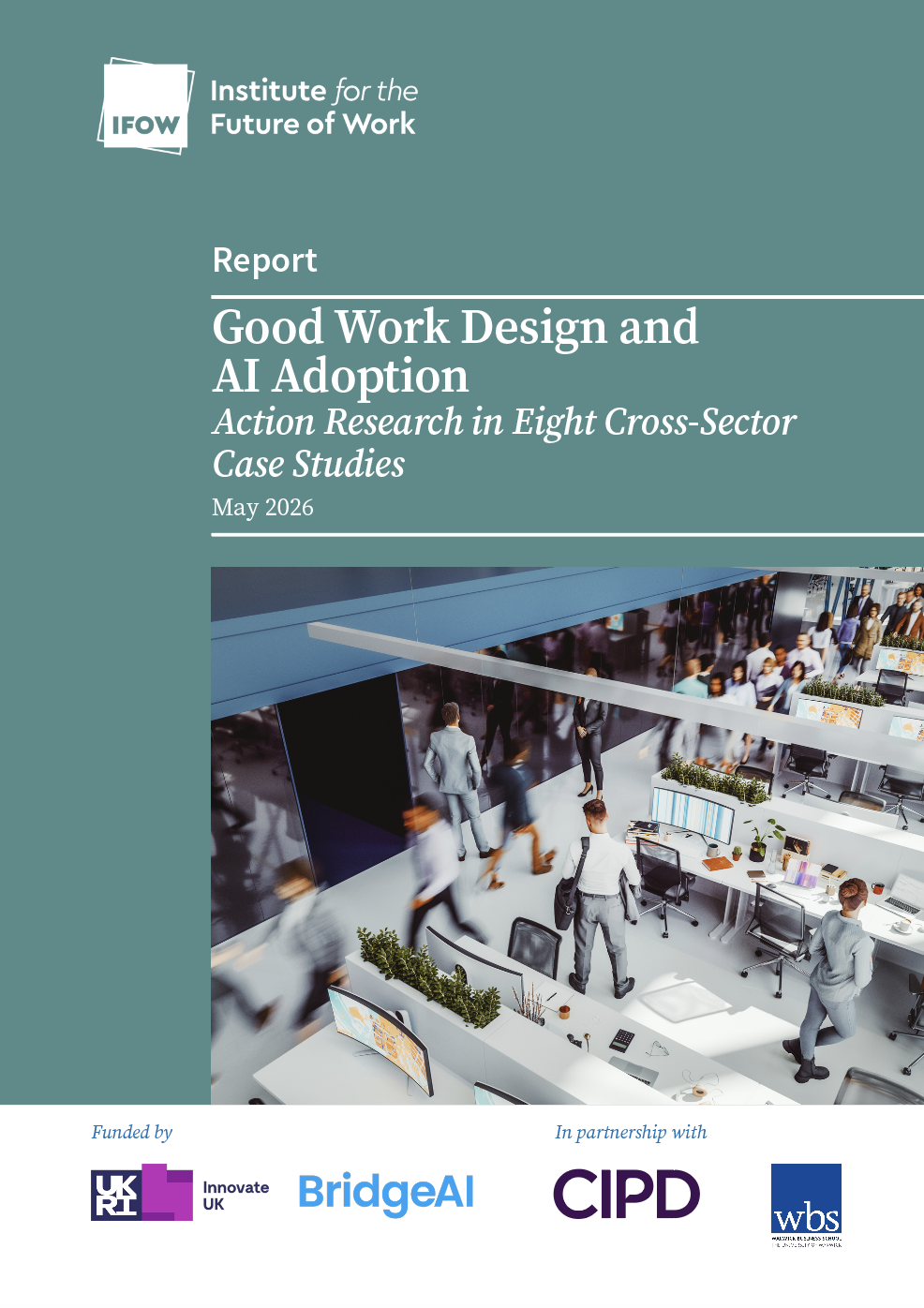
This project, conducted in partnership with the CIPD and Warwick Business School, and funded by Innovate UK’s BridgeAI programme, responds to these marked gaps in our understanding about the barriers and enablers of responsible and effective AI adoption.
Funded by Innovate UK's Bridge AI programme

Innovate UK BridgeAI empowers UK businesses in high-growth sectors, driving productivity and economic growth through the adoption of Artificial Intelligence. We bridge the gap between developers and end-users, fostering user-driven AI technologies. With a focus on ethics, transparency and data privacy, we aim to build trust and confidence in the development of AI solutions. Strengthening AI leadership, supporting workforces, and promoting responsible innovation, BridgeAI shapes a collaborative and AI-enabled future. BridgeAI is an Innovate UK funded programme, delivered by a consortium including Innovate UK, Digital Catapult, The Alan Turing Institute, STFC Hartree and BSI.
Produced in partnership with the CIPD and WBS

The CIPD has been championing better work and working lives for over 100 years. We help organisations thrive by focusing on their people, supporting our economies and societies. We are the professional body for HR, L&D, OD and all people professionals – experts in people, work and change.

With bases in Warwick and at The Shard in London, WBS is consistently ranked as one of the world’s leading business schools. WBS was a leading partner in IFOW’s Pissarides Review into the Future of Work and Wellbeing.
Anna Thomas MBE
Report
People-Centred Adoption