We use cookies to personalise and enhance your experience on this site. By clicking Accept or continuing to use the site, you agree to our use of marketing and social media cookies as described in our Privacy Policy.
Accept and close
This blog piece has been contributed by Max Fairfull, a recent graduate from the University of Exeter (2025) who is currently studying for an MA in Political and Strategic Communications at King's College London.
In July, the Financial Times released an article considering how Chat GPT had impacted the hiring prospects of graduates, given that entry roles requiring a degree have dropped two-thirds since its launch in 2022.
As a master’s student looking to work in strategic communications and currently navigating graduate scheme application processes, I expected competition - but not this scale of opportunity erosion. The situation can sometimes feel bleak for graduates irrespective of where we have studied. So, I began exploring the drivers of this tougher climate for graduates, and the contributing trends in the broader labour market.
A survey by Boston Consultancy Group has found that many of the UK’s largest employers are actively downsizing their workforce and choosing to relocate money from graduate staff to AI investment. Actions like these have led some research to position AI as a lead contributor to job and graduate opportunity losses, as in this report by outplacement firm Challenger, Gray and Christmas.
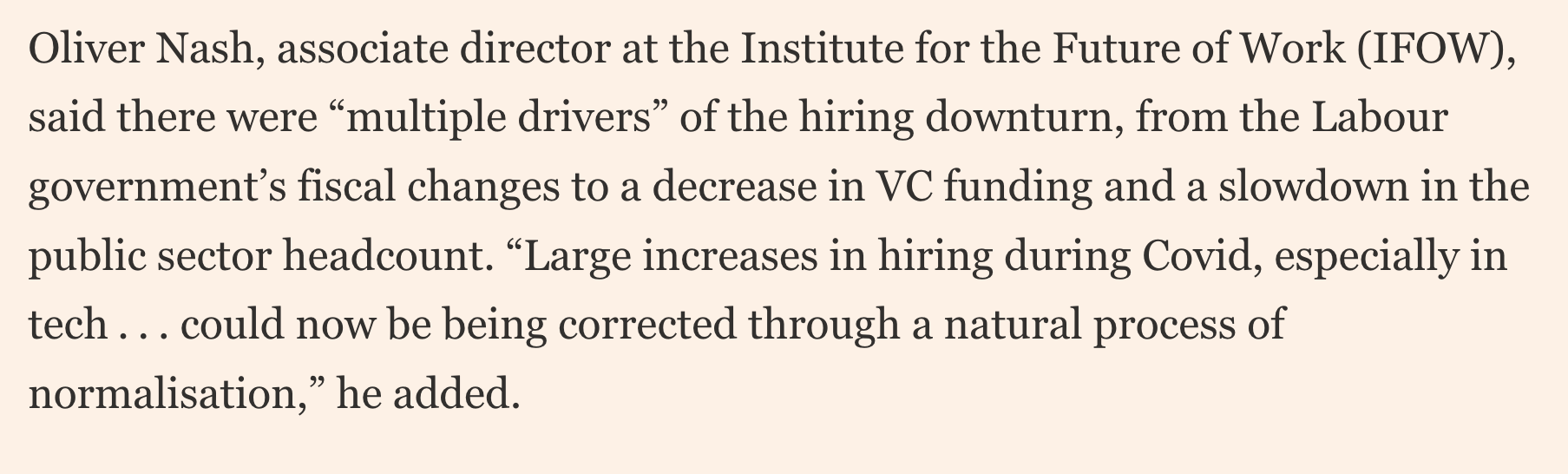
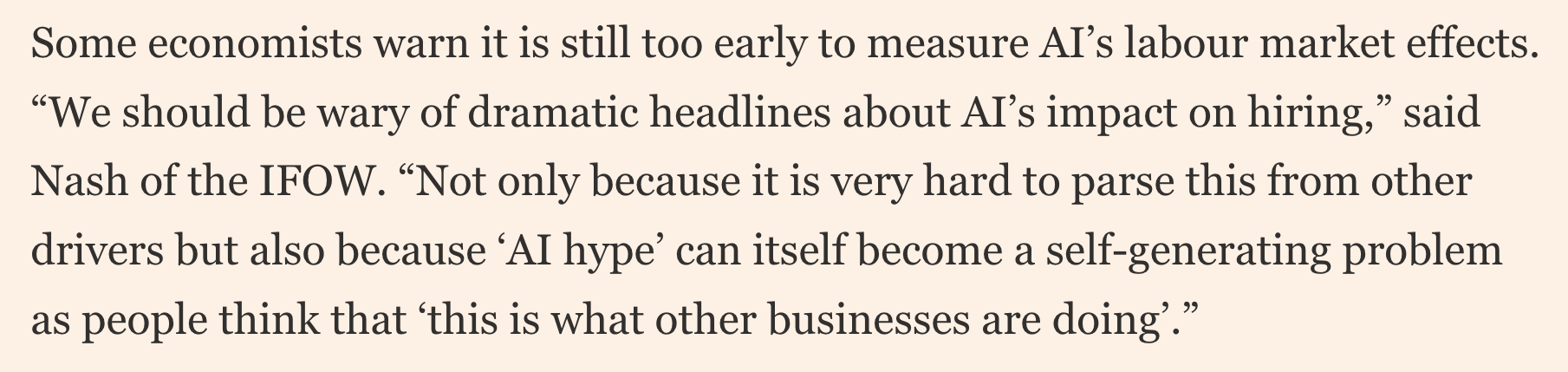
While the piece in the Financial Times accepts the AI factor, it also suggests that workforce reductions are partly due to Britain’s economic stagnation, and post-covid market normalisations, as well as hype around AI and hiring. Recent hikes in national insurance and minimum wage rises have also been identified as dissuading factors for employers looking to hire graduates. This makes it hard to isolate and identify the impact of AI directly on graduate jobs. In fact, PwC’s UK chief Marco Amitrano stated that the UK’s economic slowdown, a product of high energy costs and sluggish productivity, are ‘the single biggest factor behind a lower graduate intake at PwC this year’. The UK graduate labour market disruptions are a clearly consequence of both technological and economic factors - but which is having the greater impact?
The introduction of new technologies and linked labour market disruptions is not a new phenomenon. The introduction of steam and electricity caused seismic shifts in late 19th century employment structures (Deming, 2025). Their introduction led to the mechanisation of agriculture, resulting in a mass decline in labour demand in what was then the country's largest employment sector, while also spearheading an explosion in manufacturing employment opportunities (Deming, 2025). Whilst new technologies like AI have disrupted labour markets, they can also redirect employment from traditional sectors towards more technical and higher productivity fields. In fact, IFOW’s own research finds that the growing use of new technologies in the workplace is having significant yet varied impacts on people’s experiences of work.
In the present moment, the transforming effect of AI technologies comes with a promise of new forms of employment (such as prompt engineering) - but the short-term effects feel like a reduction of opportunity. As public and private bodies talk up incorporating AI into their business models, graduates face a shrinking pool of entry-level positions. The current scarcity of jobs available has a ‘time lag’, which emerges both from the slow adjustment of businesses and the government to new technologies, and from the time required for the workforce to develop the skills needed to thrive in a post-AI environment.
How should people respond to this? Economist Irmgard Nübler stresses that advanced economies such as the UK requires coordinated economic and social reforms to keep pace with AI-driven change (Nübler, 2016). By investing in further educating its workforce and building new societal capabilities, governments can ensure that graduates like me, and the wider workforce, remain competitive in a post-AI economy (Nübler, 2016). A systemic approach to this problem requires both an individual response, alongside reactions from the educational sector and employers.
On an individual level, graduates and the wider job seeking community can first look to understand the effects of AI on their target sector. As I seek employment within the strategic communication field, I am looking to understand how AI is affecting the sector’s employment structure and the coalescing shift of what skills are in demand. I am trying to re-frame my skill sets to match what firms are looking for, while hoping to also provide a framework of new skills to engage in learning to improve their competitiveness.
Through the Pissarides Review into the Future of Work and Wellbeing, IFOW research has shown that the skills landscape in the UK is changing, including what drives and mediates these transitions. This research has shown that, across occupations and sectors, AI and automation are raising demand for, and the importance of, human-centric skills such as creativity, problem-solving, collaboration, and initiative. Coordinated reactions from both the education sector and employers are required to address this changing landscape.
Similarly, Professor Szufang Chuang finds that employers should prioritise training new and existing employees in skills such as communication, empathy, teamwork and creativity, allowing the dismantling of current sector-specific barriers to entry. By lowering these barriers to entry, a wider pool of eligible candidates can access previously unattainable roles. These combined reactions will help equip graduates with the transferable skills necessary to thrive in a wider range of roles, allowing them to become candidates for more roles and easing over-saturation of individual sectors.
The challenges facing Britain’s graduates today are not solely the consequences of AI, but are reflective of wider economic challenges that are making early career hires unattractive. My own experience resonates with this. However, encouragement must be taken from history, that while difficult in transition, technological transformation can also create new employment opportunities in time.
The benefits of ‘good work’ have been made clear by IFOW’s research and it is key that each new generation of young people is given the opportunity to access good jobs. Government and employers must look beyond short-term promises of AI gains to prioritise a human-centred approach that focuses not on job displacement, but on the fiscal and skilling dimensions necessary for making entry-level roles attractive to firms. Only then can current UK graduates enjoy a labour market which is shaped by AI, not replaced by AI.
References:
Almeida, Lauren. “UK Graduates Facing Worst Job Market since 2018 amid Rise of AI, Says Indeed.” The Guardian, June 25, 2025. https://www.theguardian.com/money/2025/jun/25/uk-university-graduates-toughest-job-market-rise-of-ai
Boston Consulting Group. ‘Companies Must Go Beyond AI Adoption to Realize Its Full Potential.’ Boston Consultancy Group, Press Release, June 26 2025.
Challenger, Gray & Christmas. Challenger Report: August 2025. Press release, September 4, 2025.
Chuang, Szufang. “Machine Learning and AI Technology-Induced Skill Gaps and Opportunities for Continuous Development of Middle-Skilled Employees.” Journal of Work-Applied Management, November (2024): 179-195. https://doi.org/10.1108/jwam-08-2024-0111.
Deming, David J., Christopher Ong, and Lawrence H. Summers. Technological disruption in the labor market. No. w33323. National Bureau of Economic Research, 2025, p. 170
Murray, Clara, Delphine Stauss, John Burn-Murdoch, Sarah Lim. ‘Is AI killing graduate jobs.’ Financial Times, July 24, 2025. https://www.ft.com/content/99b6acb7-a079-4f57-a7bd-8317c1fbb728
Nübler, Irmgard. "New technologies: A jobless future or golden age of job creation." International Labour Office Research Department Working Paper 13 (2016): 21
Reimers, Fernando M. ’Transforming education to prepare students to invent the future.’ PSU Research Review: An International Journal, Vol.4, No. 2: 81-91
Thomas, Bethan Staton. “UK Graduate Job Openings at Lowest Level since 2018.” Financial Times, June 24, 2025. https://www.ft.com/content/efd138c2-07894f04-b820-b2a0a7200eaf
Thompson, Polly. 2025. “PwC UK Chief Explains Why the Firm Is Cutting Graduate Hiring.” Business Insider. September 8, 2025. https://www.businessinsider.com/pwc-uk-cuts-graduate-level-hiring-ai-offshoring-2025-9