We use cookies to personalise and enhance your experience on this site. By clicking Accept or continuing to use the site, you agree to our use of marketing and social media cookies as described in our Privacy Policy.
Accept and close
If the much anticipated – and much leaked – Budget last week offers a detailed insight into what the government’s strategic priorities are, we feel that there are causes for concern that need time to digest.
Analysis suggests that this is a ‘survivors’ budget’, one that seems stuck on optimistic messages about the power of AI to deliver growth, rather than one set to direct the country towards grappling with the true complexity of harnessing this set of technologies with human skill to shift the needle on productivity.
We will be offering a fuller Budget response in our mid-month spotlight and, with that, some reflections on a different narrative based on the deep work in our Pissarides Review that would model how Government, firms, and people can navigate good transitions, turning the rhetoric of resilience and renewal into reality.
In the meantime, we have a deep dive on the particularly welcome dimension of the investment in young people, and our usual roster of the best reads in the future of work space, including an excellent piece by our Research Fellow, Canhui Liu, on how AI is reshaping social structures.
Anna and IFOW
Deep Dive: Youth Guarantee
The Budget’s commitment of over £1.5bn across the spending review period for the Youth Guarantee and the Growth and Skills Levy marks a serious investment in young people.
This, amidst an overall package that points to ‘survival’ rather than truly strategic redirection of the economy towards managing the complex reality of technological transition, is to be welcomed.
Of this £1.5bn, £820m is assigned to the Guarantee itself, aligning with the Government’s concern about rising youth unemployment (now 15.3%) and a NEET rate of 12.7%.
But Budget documents confirm that these initiatives sit alongside welfare reforms designed to “rebalance” Universal Credit, so it “doesn’t pay to be off sick rather than work”. This risks pushing young people into insecure or unsuitable roles if not accompanied by stronger quality standards and employer-level good work commitments.
As research we are conducting in partnership with the EY Foundation shows (and will be published in full shortly), fragmented careers support and local variation remain major obstacles.
The Government’s creation of Skills England and the Growth and Skills Levy is welcome, but the Budget does not yet provide the integrated, area-based delivery model that our Pissarides Review recommended.
The raising of the National Living Wage and National Minimum Wage is also welcome. These progressive moves should give more capacity to families, supporting parents and those in precarious work to be able to build capabilities, access upskilling and target more good work opportunities.
However, if we are to see this ‘survival’ budget do something more strategic to help the country better navigate this period of major technological disruption, these policies must be complemented by other forms of support for workers in transition.
Interesting Reads
From Human Networks to Human–Machine Networks: How AI is Reshaping Social Structure | IFOW Research Fellow Canhui Liu
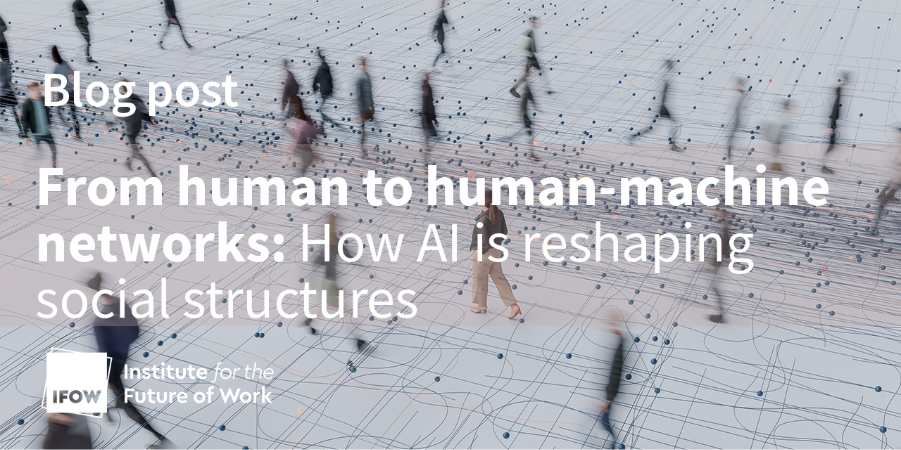
We often think of AI in terms of innovation or automation. But, as Research Fellow Canhui Liu outlines in this new blog post for IFOW, AI is not only a tool - it is a structural force that is remodelling how people connect, how organisations function, and how inequalities evolve.
If you are working in a sector where AI is changing workplace practices, professional networks, or community life, Canhui would love to hear from you. How is AI reshaping the way you connect, collaborate, or progress in your role? Fill in this form to share your experiences of work.
Artificial Intelligence Technologies and Employee Pay in the United Kingdom | Felix Schulz, Danat Valizade, Mark Stuart, Magdalena Soffia and Jolene Skordis
How is AI influencing pay in the UK? This paper, co-authored by IFOW’s Associate Director of Social Research Dr Magdalena Soffia, and recently published in the British Journal of Industrial Relations, uses nationally representative employee and employer data to examine how AI and pay in relation to skills level and the strength of workplace voice mechanisms.
Liberalism can win back the working class. Here’s how | Daron Acemoglu for the Financial Times (£)
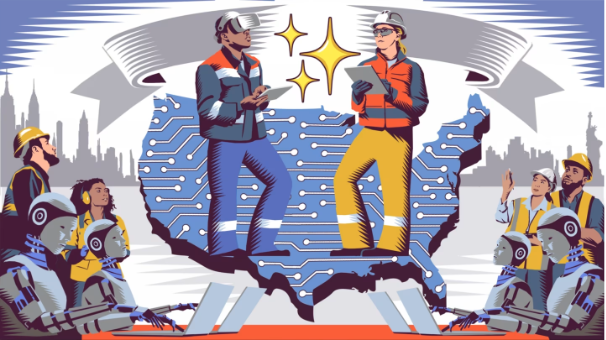
Digital technologies have unmade shared prosperity, contributing to the crisis of liberal democracy in post-industrial society. In this article for the FT, economist Daron Acemoglu lays out how pro-worker AI strategies can support wage growth and job creation, using new technologies to enable shared prosperity rather than dismantle it.
AI and labour markets: What we know and what we don’t know | Stanford Digital Economy Lab
Amid widespread uncertainty about the actual impact of AI on labour markets, this article takes stock of the latest research to date, considering hiring trends for entry-level jobs, firm AI adoption, training in jobs and the impact of AI on pay and income.
As part of the Pissarides Review, a three-year study into how work is changing and how workers in Britain are coping through technological transformation, this working paper examines the workers’ exposure to new types of technology and the varying impacts on worker wellbeing.
The Impact of Generative AI on the Novel | Dr Clementine Collett, co-published by the Minderoo Centre for Technology and Democracy and IFOW
More than half of novelists (51%) in the UK believe AI is likely to replace their work. Novels are an important bedrock of the creative industries, which contribute enormous cultural and economic value to the UK annually.
In a blog for IFOW, Dr Clementine Collett lays out her major findings and key recommendations for the Government to protect novels and novelists, who contribute so substantially to our culture, education, identity and wellbeing.
AI in the street: Lessons from everyday encounters with AI innovation | Careful Industries
Number plate recognition cameras, automated traffic light systems, and digital billboards… how do local communities make sense of data-intensive and AI-based technologies in their everyday environments? This report finds a disconnect between government discourse on the societal benefits of AI, and the needs of people in the urban environments where AI innovation takes place.
Making Talk Cheap: Generative AI and Labour Market Signalling
Writing has traditionally been held as a signal of quality – employers using cover letters to filter job applications, or university assessments based on written essays. This paper explores how LLMs, like ChatGPT, disrupt the signal value of written communications on hiring patterns and labour market efficiency by lowering the cost of written content.
AI and the Future of the Workforce: What comes next? | Deel
As more companies integrate new technologies, workforces are rapidly changing. A policy report from HR platform Deel draws on global data to show how AI is reshaping the recruitment, management and evaluation of workers, while also tracking regulatory trends across hiring and promotion, worker data and transparency, and skills transitions. From the Deel report:
Our research into firm-level adoption of AI, based on hundreds of hours of worker interviews, finds that technological transformation is having significant and divergent changes to people's jobs and experience of work.
Technology regulation and the challenge of infrastructural power | Nexa Centre for Internet & Society
Political economy has been transformed by networked, programmable, platformised digital infrastructures and supply chains. This panel discusses how understanding infrastructural power is a necessary first step to developing more effective governance institutions.
When managers let AI do the talking, everyone loses | Raconteur

Using AI chatbots to assist with performance reviews might save managers time and effort, but at the cost of eroding trust and respect at work. This article examines the impacts of managers outsourcing employee feedback to machines, and the risks of AI-generated slop in employee evaluations.
Artificial general intelligence: dignity over transparency | Liat Lavi
Could the anthropomorphic design of LLM-based chatbots have been regulated differently? This article looks at the implications of ascribing algorithms subjectivity.
The means of prediction (£) | Maximilian Kasy
Despite its ubiquity, AI’s prevalence has occurred through a series of human decisions on design, development, and deployment. This book looks at the essential resources for building AI systems – data, computing, power, expertise, and energy – and who controls these new technologies.

In a recent blog for IFOW, Professor Phoebe Moore considers this in-built technological unpredictability in a regulatory context.
Events
TechUK Digital Ethics Summit 2025 | 3 December 2025, in-person
This year’s Digital Ethics Summit examines the current health of digital ethics by looking back over a year of progress and change. Sessions will look at compliance and audit, assurance and public trust, the ethics of continuing technological developments and geopolitical shifts more broadly.
All-Party Parliamentary Group on the Future of Work: Good jobs and regional growth | 9 December 2025, hybrid
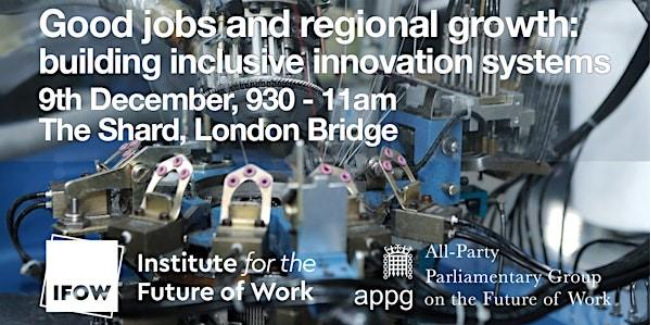
We’re excited to announce the next APPG on the Future of Work. As powers are devolved to local leaders, how can we build inclusive innovation systems that support good jobs and regional growth?
Join for a session convening parliamentarians, regional leaders and policy experts to consider safeguards and fair standards, and how national and regional leaders can work together to deliver inclusive growth. Our in-person ticket allocation is full, but please do join online.
Dilemmas and regulation of delegation| 10 December 2025, in-person
Join the Ada Lovelace Institute for this discussion on the development and market distribution of Advanced AI Assistants, the risks they may pose and their required governance.
Taking better care of our workers | 11 December 2025, hybrid
How can a Fair Pay Agreement improve conditions for social care staff? Join the Resolution Foundation for discussions on the new Adult Social Care Negotiating Body (ASCNB) and how this can deliver lasting improvements to care workers’ conditions.
Making the Future Work | 12 March 2026
We’re delighted to announce that our Making the Future Work conference will be held on 12 March 2025. IFOW will convene policymakers, academics, investors, technologists, technology adopters, and civil society organisations to collaborate on how we can truly make the future work.