We use cookies to personalise and enhance your experience on this site. By clicking Accept or continuing to use the site, you agree to our use of marketing and social media cookies as described in our Privacy Policy.
Accept and close
By Felix Schulz, Danat Valizade, Mark Stuart, Magdalena Soffia, and Jolene Skordis
As artificial intelligence (AI) becomes increasingly embedded in the workplace, concerns about its impact on jobs and wages are intensifying. Public debate often focuses on automation and job loss, yet far less attention has been paid to how AI influences the quality of jobs – especially pay.
Our new study – funded by the Economic and Social Research Council through the ESRC Centre for Digital Futures at Work and the Nuffield Foundation via IFOW’s Pissarides Review, – provides the first nationally representative evidence on how AI technologies are shaping employee pay in the United Kingdom.
Rethinking technology and pay
Traditional economic theories suggest that digital technologies tend to favour high-skilled workers. According to the skill-biased technological change (SBTC) view, new technologies increase demand for skilled labour and thereby widen pay inequalities. The routine-biased technological change (RBTC) perspective refines this argument, suggesting that technology replaces routine tasks – often middle-skill jobs – resulting in a polarised labour market.
However, these theories often overlook the social and institutional dynamics within workplaces. Drawing on labour process and industrial relations scholarship, we take a non-deterministic approach: technology’s effects on workers depend not only on their skill levels and tasks performed, but also on power relations and employee voice in decision-making.
Matching data on employers and employees
To investigate these dynamics, we combined two unique, nationally representative datasets:
We matched these datasets by industry, region, and establishment size, creating a multi-level dataset linking employer technology practices with employee pay outcomes.
Applying machine learning to labour research
To uncover complex, non-linear relationships that traditional models might miss, we applied machine learning techniques. This approach enabled us to robustly test how both employer-level AI adoption and employee-level AI use predict pay, while accounting for factors such as education, occupation, gender, age, and union presence.
What we found
AI adoption and use are positively associated with pay
Workers who regularly use AI tools tend to earn higher wages. Similarly, in clusters where AI adoption is more widespread, average pay levels are higher.
Lower-skilled workers benefit disproportionally – but only when AI is deeply integrated into their work
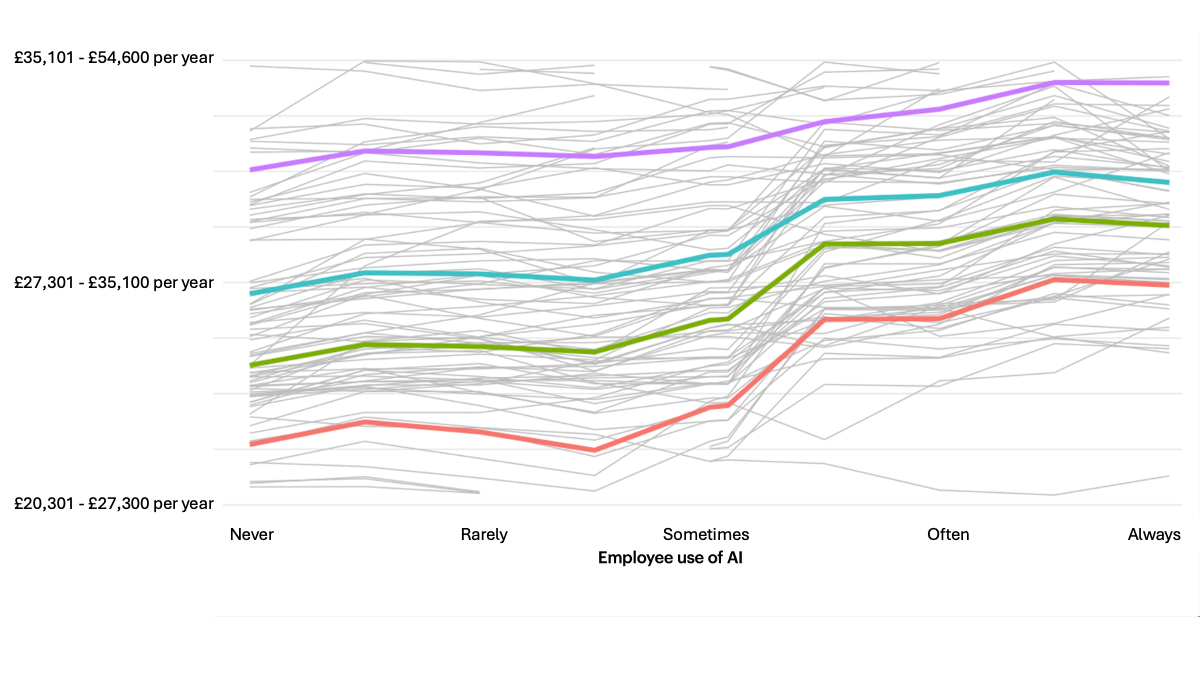
Contrary to earlier digitalisation trends that mainly favoured the highly educated, we found that frequent interaction with AI can raise pay among lower-skilled and less-qualified workers (see Figure 1 below).
Figure 1: Workers who interacted more frequently with AI were more highly paid
Employee involvement in pay decisions promotes fairness
In workplaces where employees are consulted, or negotiate over pay, the distribution of AI-related pay gains is more equitable. In these contexts, the lowest-qualified workers experience the largest pay uplifts.
Implications for the future of work
Our findings offer a more nuanced picture of AI’s effects on workers. AI adoption, rather than displacing jobs, can enhance pay – especially when paired with mechanisms of employee voice. Strengthening consultation and participation in pay decisions can ensure that the benefits of AI are shared more evenly across the workforce.
However, challenges remain. Only around one in three UK employers have invested in AI technologies to date. Only a third of employers involve employees in discussions about pay, and just one in four in decisions around investments in technology.
Without broader adoption and stronger workplace dialogue, the potential of AI to promote fairer pay outcomes may remain unrealised.
Looking ahead
This study shows how matching representative employer and employee data – combined with machine learning – can deepen our understanding of the social consequences of AI. As AI continues to transform work, ensuring that technological change aligns with equitable pay and worker participation will be vital for building a fair digital future of work.